
1. 需求
累加器是什么?累加器怎么用?别急,一项新技术的诞生,基本都是为了满足某种需求,从需求出发,更容易理解这个函数的特点。
为方便理解,假设有一个 int 一维数组,储存 5 个数字,求出第一个值(-1)加上第二个值(0)的和(-1),再将求得的值(-1)和数组的第三个数(3)相加,再次求和(2),再次将该值和数组的第四个数(5)相加。。。以此类推,得出其实就是:int result = -1 + 0 + 3 + 5 + 8;
int[] numbers={-1, 0, 3, 5,8};
1.1 基本需求
//V1.0版本
static void Main(string[] args)
{
    int[] numbers = { -1, 0, 3, 5, 8 };
    int result = numbers[0];
    for (int i = 1; i < numbers.Length; i++)
    {
        result = result + numbers[i];
    }
    Console.WriteLine(result);//输出15
    Console.ReadKey();
}
1.2 封装算法部分
把中间的算法提取出来,这样可以输入其他不同长度的 int 类型数组了:
//V1.1 版本
static void Main(string[] args)
{
    int[] numbers = { -1, 0, 3, 5, 8 };
    var result = Aggregate(numbers);
    Console.WriteLine(result);
    Console.ReadKey();
}

static int Aggregate(int[] array)
{
    int result = array[0];
    for (int i = 1; i < array.Length; i++)
    {
        result = result + array[i];
    }
    return result;
}
1.3 不只是实现加法–算法替换
累加器要做到不是只能做加法,例如:
int result = -1 * 0 * 3 * 5 * 8;

int result = -1 - 0 - 3 - 5 - 8;
//V1.2 版本,实现算法替换
//需了解委托,Lambda相关知识
static void Main(string[] args)
{
    int[] numbers = { -1, 0, 3, 5, 8 };
    var result = Aggregate(numbers,(result,next)=>result * next);//实现乘法
    //var result = Aggregate(numbers,(result,next)=>result - next);//实现减法
    Console.WriteLine(result);
    Console.ReadKey();
}

static int Aggregate(int[] array,Func<int,int,int> func)
{
    int result = array[0];
    for (int i = 1; i < array.Length; i++)
    {
        result = func(result, array[i]);
    }
    return result;
}
1.4 不只是 int 类型–泛型
目前该算法int Aggregate(int[] array,Func<int,int,int> func)只支持 int 类型,现在要扩展到任意类型–泛型。
//V1.3 版本,实现泛型
//需了解泛型,IEnumerator接口相关知识
static void Main(string[] args)
{
    int[] numbers = { -1, 0, 3, 5, 8 };
    var result = Aggregate(numbers, (result, next) => result + next);
    Console.WriteLine(result);
    Console.ReadKey();
}

static TSource Aggregate<TSource>(IEnumerable<TSource> source,Func<TSource, TSource, TSource> func)
{
    using (IEnumerator<TSource> e = source.GetEnumerator())
    {
        if (!e.MoveNext())
        {
            throw new ArgumentException();
        }

        TSource result = e.Current;
        while (e.MoveNext())
        {
            result = func(result, e.Current);
        }

        return result;
    }
}
1.5 实现方式变成拓展方法
直接对实现了 IEnumerator 接口的类,添加扩展方法。至此,该 Aggregate 实现的功能已经和官网提供的累加器相似了。
//V1.4 版本,扩展方法
class Program
{
    static void Main(string[] args)
    {
        int[] numbers = { -1, 0, 3, 5, 8 };
        var result = numbers.Aggregate((result, next) => result + next);
        Console.WriteLine(result);
        Console.ReadKey();
    }
}

public static class Helper
{
    public static TSource Aggregate<TSource>(this IEnumerable<TSource> source, Func<TSource, TSource, TSource> func)
    {
        using (IEnumerator<TSource> e = source.GetEnumerator())
        {
            if (!e.MoveNext())
            {
                throw new ArgumentException("需要至少两个元素");
            }

            TSource result = e.Current;
            while (e.MoveNext())
            {
                result = func(result, e.Current);
            }

            return result;
        }
    }
}
2. 微软提供的 API
在 System.Linq 命名空间下,提供了:
1. public static TSource Aggregate<TSource>(this IEnumerable<TSource> source, Func<TSource, TSource, TSource> func);

2. public static TAccumulate Aggregate<TSource, TAccumulate>(this IEnumerable<TSource> source, TAccumulate seed, Func<TAccumulate, TSource, TAccumulate> func);

3. public static TResult Aggregate<TSource, TAccumulate, TResult>(this IEnumerable<TSource> source, TAccumulate seed, Func<TAccumulate, TSource, TAccumulate> func, Func<TAccumulate, TResult> resultSelector);
其中第一个接口,与我上述举例的功能一样。其他两个功能放后面讲解(有时间的话)。
3.由浅入深
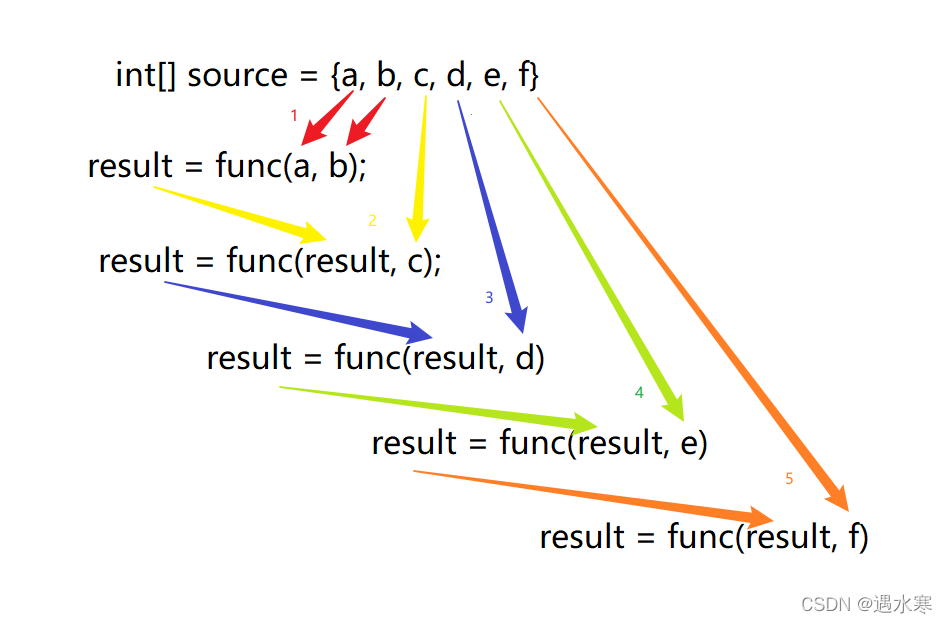
如果是初学者,可能大脑第一反应还是觉得这个Aggregate只能加减乘除,如果这样想,说明其实还是理解得不够深刻,现在来深度剖析该方法的传参:func。
如下图所示,累加器会遍历每一个元素,除了第一次,是直接拿第一和第二个元素进行 func 运算之外,从第三个开始,都是拿上一次的计算结果 result 作为 func 的第一个输入参数,第二个输入参数为数组的下一个元素,直到遍历到最后,返回一个最终的 result 值。
实际使用:当数据库中一张表引用了多张表的外键,当需要查询这些外键的时候,就可以使用累加器,把需要查询的条件累加起来,向数据库进行查询。