Flutter is an open source mobile UI framework developed by Google that quickly builds high-quality native user interfaces on different platforms. Flutter supports all existing code and is increasingly sought after by developers around the world. So far, nearly half a million apps using Flutter have been released around the world, including apps from large companies such as ByteDance, as well as apps from thirty Google teams. According to analysts at Statista and SlashData, Flutter is the most popular cross-platform UI tool in 2021.
finishing| Guo Lu
produced| CSDN(ID:CSDNnews)
On February 4, Flutter's stable version 2.10 was launched. This version was released during the Spring Festival, less than two months since its last release. But even in this short period of time, we have closed 1843 issues and 1525 PRs from 115 contributors around the world. This release update includes Flutter's major support updates for Windows, some performance improvements, new features on different platforms, and improvements to some tools.

Overview of new features in Flutter 2.10
1. performance improvements
Flutter 2.10 initially supports the drawing dirty area management function provided by Flutter community member knopp. He enabled selective repainting for individual dirty areas on iOS/Metal. This will significantly shorten the rasterization time for the ninetieth and ninety-ninth tenths in some benchmarks, and reduce GPU occupancy in these benchmarks from over 90% to below 10%.
In addition, this version also optimizes the image format. Developers can adjust layer transparency more effectively. The rasterization time per frame was reduced by at least one-third in the benchmark.
In profile and release modes, Dart code is compiled in AOT mode. This code unlocks many compiler optimizations and aggressive tree-shaking. However, since type flow analysis must cover the entire program, it has some impact on performance. 2.10 Version brings faster implementation of type flow analysis. In benchmark testing, the overall build time for Flutter applications was reduced by approximately 10%.
2. iOS update
In addition to performance improvements, Flutter 2.10 also adds different enhancements across various platforms. For example, developer luckysmg has brought smooth iOS keyboard animations, improved stability for iOS camera plug-ins, and added a new feature to the 64-bit iOS system that reduces memory usage-compressed pointers.
3. Android updates
At the same time, Flutter 2.10 version has been improved for Android. When developers create new apps, Flutter can support the latest version of Android, Android 12. In addition, in this release, we have enabled MultiDex. If a developer is using an Android SDK version lower than 21 and exceeds the 64K method limit, you can support MultiDex by passing--multidex to the Flutter Build Appbundle or Flutter Build Apk.
4. web updates
The Flutter version also includes improvements to the Web. In previous versions, when the mouse was dragged over the edge of a multi-line text box, it did not scroll synchronously. In version 2.10, after the selection cursor drags out of the text box, the text box will scroll, browse and select the corresponding content. This feature is available for Wed and desktop applications.
5. Material 3
Flutter 2.10 is the beginning of the transition to Material 3, which includes the ability to generate an entire color scheme from a single color.
Developers can create new ColorScheme types using any color. ThemeData's constructor also contains a new colorSchemeSeed parameter, which allows you to generate themes directly from colors. In addition, this version includes parameters for ThemeData.useMaterial3 to switch the widget to the new Material 3 appearance. Flutter also added 1028 new Material icons.

In addition to the above features, Flutter 2.10 also makes improvements in integration testing, DevTools, and VSCode, and completely removes the Dev channel and support for iOS 9.3.6.
The most eye-catching thing about this version update is the stable support for Windows application development. In this regard, Flutter product manager Tim Sneath issued a detailed explanation, let us take a look together.
Flutter is ready for Windows

Flutter aims to create efficient cross-platform software frameworks and has made great progress in the past few years. Flutter can develop applications for Android, iOS, Linux, Windows, macOS and the web, and is compatible with all existing code. It is supported and trusted by developers from all regions around the world.
"Today marks a major expansion of this vision, releasing support for Windows as an application target for the first time, allowing Windows developers to benefit from the same productivity and power that mobile developers have always enjoyed," Google said.
To achieve this goal, Google has been committed to Flutter development. Five years ago, Google launched Flutter Alpha, a version that greatly accelerated the development of mobile operating systems. Flutter applications can be written using Dart and run on Android, iOS, Windows, macOS and Linux, web and embedded devices.
However, it is not easy to achieve Flutter desktop support and must be redesigned for Windows. Desktop applications need to be compatible with different hardware such as keyboard and mouse and screens of different sizes. They also have different requirements for input methods, visual styles, etc., and also support various data storage contents such as file system selectors and the Windows registry.
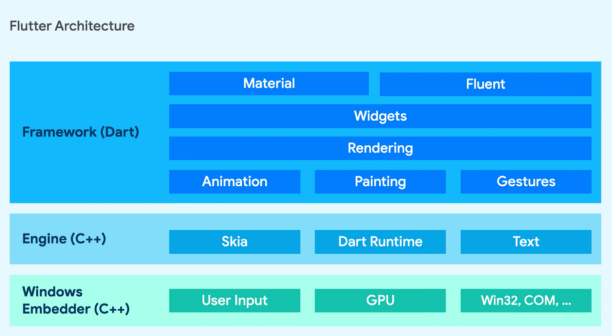
Just like Flutter's support for Android and iOS, Flutter's Windows combines the Dart framework with the C++ engine. Windows and Flutter communicate through an embedded layer, which hosts the Flutter engine and is responsible for translating and distributing Windows information. Flutter and Windows draw the UI to the screen and match it with existing Windows models.

Developers can use all the features of the Flutter framework on Windows and communicate with Win32, COM and Windows Runtime APIs through platform plug-ins written in Dart or C++, while the Flutter team has also adapted many common plug-ins to support Windows, including camera, file_picker, and shared_preferences. What's more, there has been a lot of Windows support for other packages added to the Flutter community, covering everything from Windows taskbar integration to serial port access.
Hundreds of packages already support Flutter applications built for Windows

For a fully customized Windows UI, you can also use the package fluent_ui to fluent_acrylic to create an application that beautifully expresses the Microsoft Fluent design system. Using this msix tool, you can package your applications in an installer that can be uploaded to the Microsoft Store on Windows.
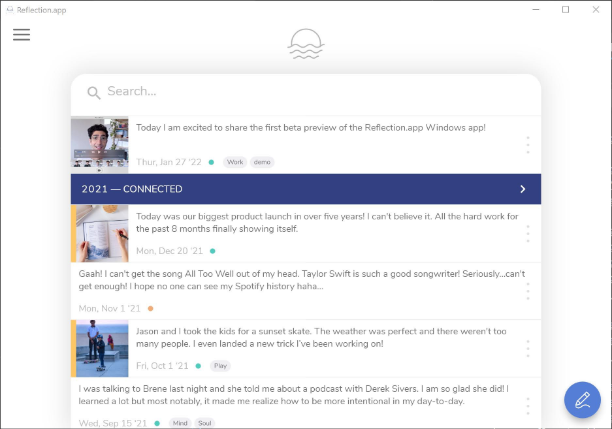
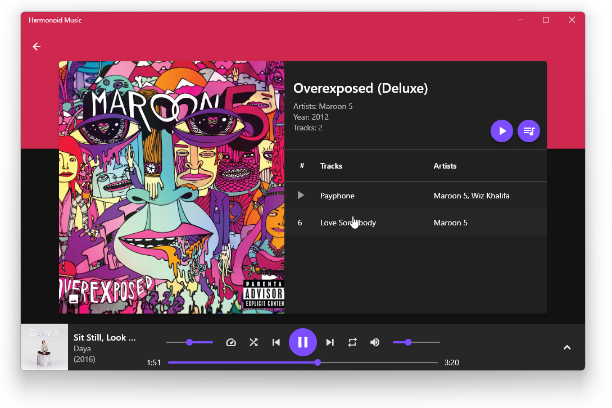
Overall, the launch of Flutter 2.10 enables fast running on Windows and can be transferred to other desktop or mobile devices as well as to the Web. The following are early examples:


After the release, Kevin Gallo, vice president of Microsoft Windows Developer Platforms, said: "We are very excited to see Flutter implement support for creating Windows applications. As an open platform, Windows welcomes all developers to join. Flutter can support Windows applications and be available on the Microsoft Store, which shows its trust in us and looks forward to the development of Flutter on Windows!"
In addition, many Flutter partners are also adding support for Windows, including:
FlutterFlow, a low-code Flutter application design tool, announced support for Windows and will help Flutter developers build features specifically for desktop use.
The latest version of Realm, a local data storage tool, supports using Flutter to build Windows applications, using Dart FFI to quickly access underlying databases, and adds existing support for mobile platforms such as iOS and Android.
Nevercode has updated the Codemagic CI/CD tool to support Windows, allowing users to test and build Windows applications in the cloud and automatically deploy them to the Microsoft Store.
Syncfusion has updated widgets to support Windows. Data visualization components and other support the creation of PDF files and Excel tables.
Rive has announced the upcoming Windows version of its graphics tool suite that allows developers to create interactive vector animations that can use state machines to respond to code in real time. They will also launch Windows apps that perform well in terms of performance and memory and will soon be available for download in the Microsoft Store.
At present, it seems that everyone's evaluation of Flutter 2.10 is still very good. What are your expectations for the release of Flutter 2.10? Welcome to leave a message below.
- [References]*
- https://www.theregister.com/2022/02/04/flutter_windows_production_release/
- https://medium.com/flutter/announcing-flutter-for-windows-6979d0d01fed
- https://www.mongodb.com/developer/article/introducing-realm-flutter-sdk/
- https://medium.com/flutter/whats-new-in-flutter-2-10-5aafb0314b12
Copyright statement: This article is an original article by CSDN blogger "Technical Vision" and follows the CC 4.0 BY-SA copyright agreement. Please attach a link to the original source and this statement to reprint it.
Original link: https://www.example.com